Net fabric has quietly become one of the most versatile materials in Indian textiles. It shows up in dupattas, sarees, blouses, wedding decor, and even religious drapes, and yet most buyers know surprisingly little about what actually makes one net fabric different from another. As wholesale fabric traders based in Manek Chowk, Ahmedabad since 2017, this is a question we get asked often, especially by retailers stocking up for wedding and festive seasons.
Here’s a straightforward guide to help you understand plain net fabric before you buy.
What is Plain Net Fabric?
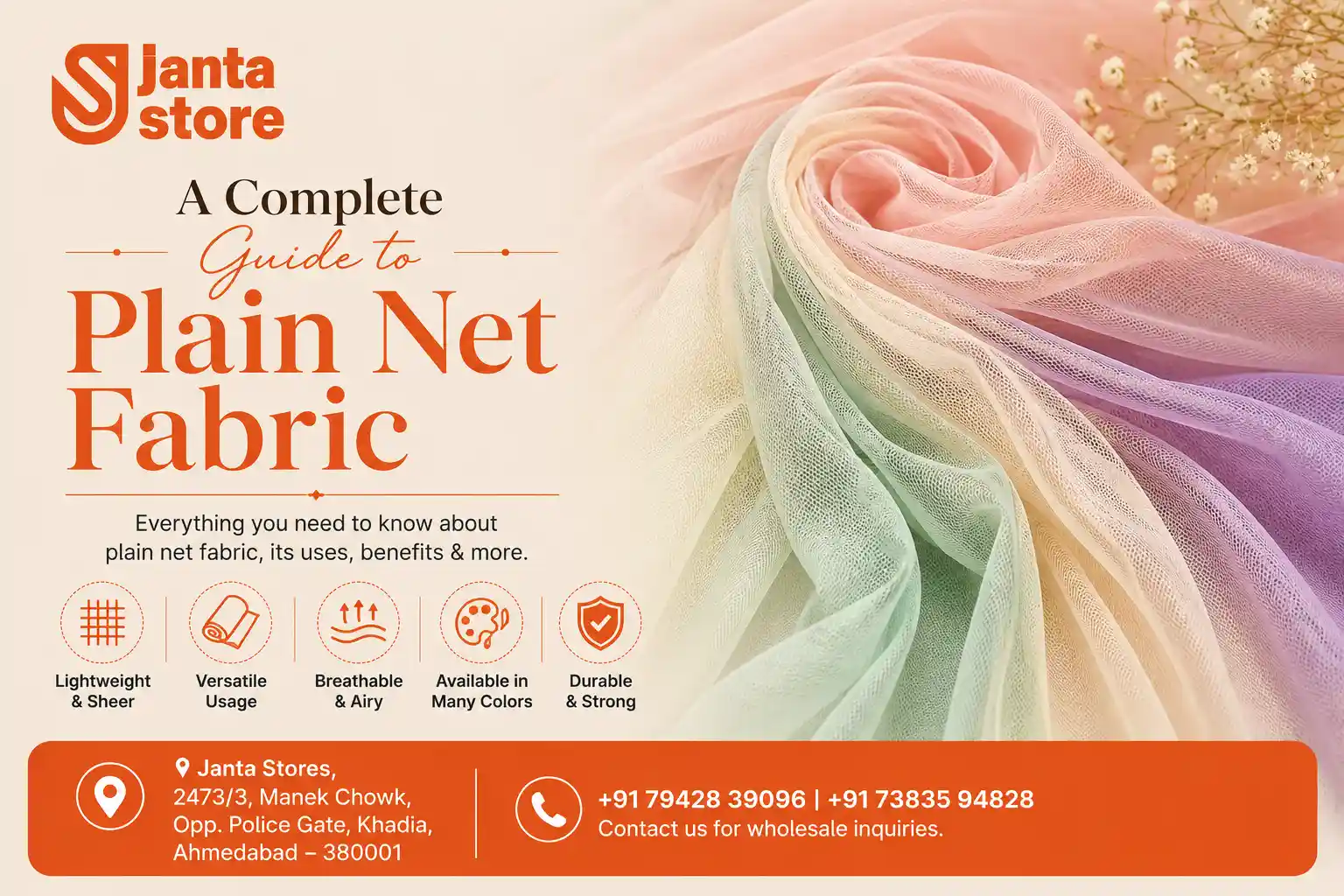
Plain net fabric is a lightweight, sheer, open-weave textile made by knotting or weaving threads in a grid pattern, leaving small gaps between them. This is what gives net its signature see-through, airy texture. Unlike woven fabrics such as cotton or silk, net fabric doesn’t have a tight, closed structure, which is exactly why it drapes so differently and is used in such different ways.
“Plain” simply means the fabric hasn’t been embellished with embroidery, sequins, or prints; it’s the base material, ready to be styled, layered, or further embellished depending on what it’s being used for.
Common Types of Net Fabric
Not all net fabric is the same. Here are the main variations you’ll come across:
- Soft Net — very lightweight and delicate, commonly used for dupattas and light layering
- Hard Net (Stiff Net) — holds shape better, often used in ghagras, lehengas, and structured garments
- Diamond Net — has a slightly textured, diamond-shaped weave, popular for both clothing and decor
- Bridal Net — a finer, premium-grade net typically used for wedding dupattas and veils
Knowing which type you need depends entirely on the end use; a lehenga needs structure, while a dupatta needs flow.
What Is Plain Net Fabric Used For?
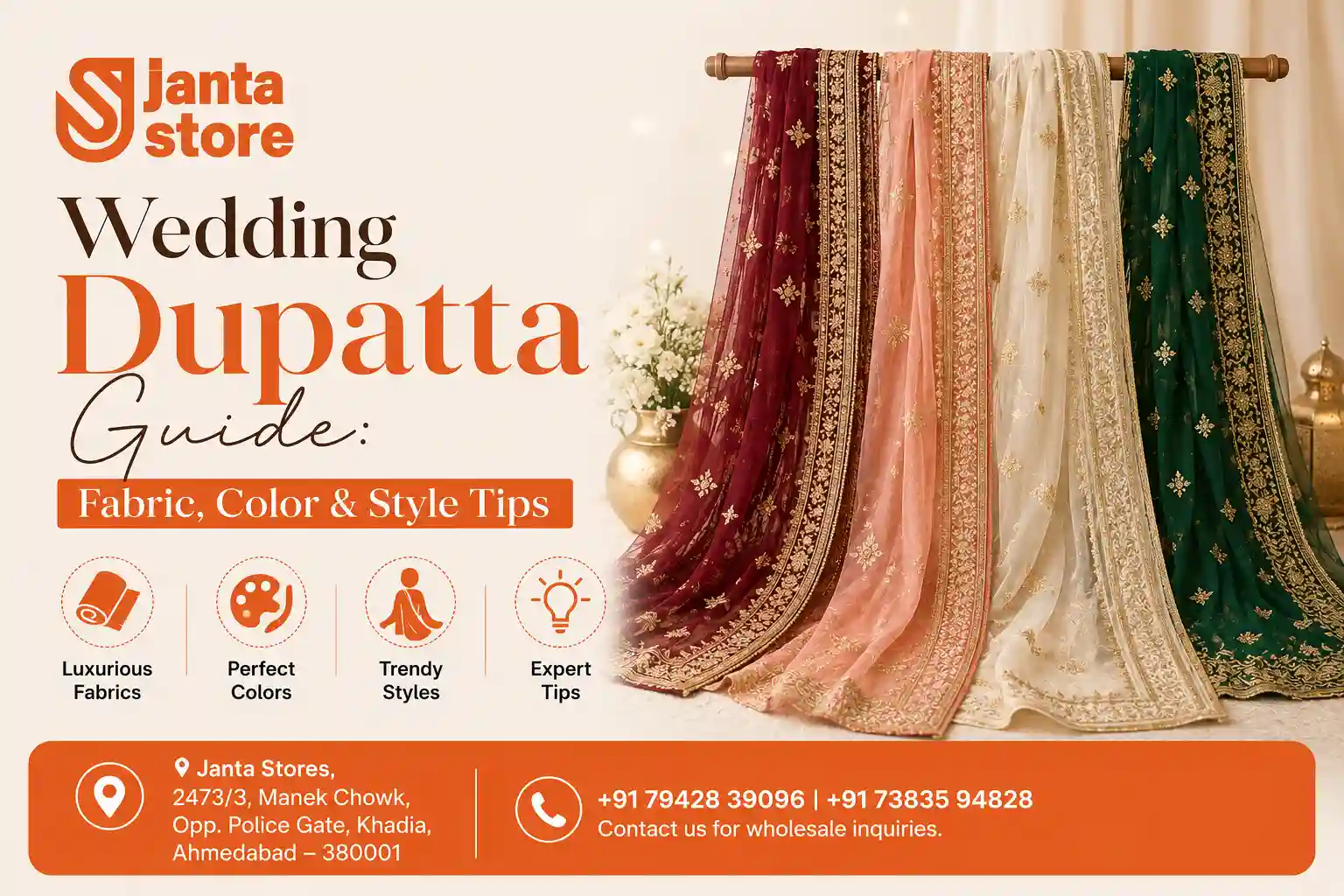
- Dupattas and stoles — layered over cotton or silk for a soft, flowing finish
- Sarees and blouses — especially popular for party wear and festive collections
- Lehenga layering — added as an outer layer for volume and movement
- Wedding and event decor — net is widely used for stage draping, mandap decoration, and backdrops
- Religious fabric use — plain net is also commonly used as a base or overlay in draped fabric for statues and decorative religious settings
This range of uses is exactly why net fabric remains one of our steadier wholesale categories; it moves across multiple buyer types, from garment retailers to event decorators.
How to Choose the Right Plain Net Fabric
If you’re buying net fabric — whether for retail stock or a specific project — here’s what to check:
- Weave tightness — a slightly denser weave holds embellishment (like embroidery or stone work) better if you plan to add it later
- Fall and drape — softer net drapes closer to the body, while stiffer net holds volume; test by holding a length up and letting it fall naturally
- Colour and dyeing quality — check for even colour distribution, especially in bulk orders, since uneven dyeing is a common quality issue in net fabric
- Fabric width — net typically comes in standard widths, but always confirm before ordering in bulk to avoid wastage during stitching
A Practical Tip From Years of Trading
One thing many first-time buyers don’t realise: net fabric shrinks and behaves differently once cut and stitched compared to how it looks on the roll. If you’re ordering in bulk for a retail line or an event, it’s worth ordering a small sample length first and testing the drape and stitching behaviour before committing to a large order. This one step saves a lot of rework later.
Net Fabric vs Other Sheer Fabrics: How to Tell the Difference
Buyers often confuse net with other lightweight, sheer fabrics like georgette, organza, or chiffon. While they can look similar from a distance, they behave very differently once worn or stitched:
- Net vs Georgette — georgette has a slightly crinkled, matte texture and is woven (not knotted like net), giving it a softer, less structured drape. Net holds its open-weave, slightly stiffer character even when soft.
- Net vs Organza — organza is crisp and has a subtle sheen, and it holds its shape stiffly, almost like it can stand on its own. Net, even in its stiffer variants, is more flexible and doesn’t hold as rigid a structure.
- Net vs Chiffon — chiffon is a closed weave, meaning it’s sheer due to the fineness of the yarn rather than visible gaps. Net’s transparency comes specifically from its open, grid-like weave, which is why it has that distinct dotted or diamond visual texture up close.
Knowing this difference matters when you’re placing a bulk order, because a supplier or retailer asking for “sheer fabric” without specifying the type can end up with a very different result than expected.
Why Net Fabric Remains a Steady Wholesale Category
From a trading perspective, net fabric holds a fairly unique position. Unlike dhoti or poshak fabric, which see clear seasonal spikes around specific festivals or wedding months, net fabric demand stays relatively consistent through the year. This is because it’s used across so many different segments — garment manufacturers, boutique tailors, decorators, and even religious fabric buyers all draw from the same base stock.
We’ve found that retailers who stock a small but well-chosen range of net fabric — a soft variant for dupattas, a stiffer variant for lehengas, and a mid-weight option for general use — tend to move inventory more consistently than those who stock only one type in bulk. Diversity within the category, rather than volume in one type, tends to serve a wider customer base.
Working With Net Fabric: Tips for Tailors and Retailers
If you’re a tailor, boutique owner, or retailer working with net fabric regularly, a few practical points can save time and reduce wastage:
- Cutting — net frays less than woven fabrics but can still shift during cutting due to its open structure. Pinning it down firmly to a stable surface before cutting helps maintain accuracy.
- Stitching — a fine, sharp needle and a slightly looser tension setting on the machine prevents the fabric from puckering along seams.
- Layering — net is most commonly used as an outer or accent layer rather than a standalone fabric for full garments, since its sheerness usually needs a base layer underneath for coverage.
- Storage — net should be stored rolled rather than folded for long periods, as sharp folds can leave permanent crease lines in the open weave that are difficult to remove.
These small handling details are often overlooked but make a real difference in how the final product turns out, especially for bulk orders meant for retail.
Explore Our Fabric Range
We supply a range of fabrics beyond net as well, including cotton dhoti fabric and silk dhoti fabric, all available for wholesale. Browse our full range on the shop page, or get in touch for net fabric availability, colours, and bulk pricing.
📍 Janta Stores, 2473/3, Manek Chowk, Opp. Police Gate, Khadia, Ahmedabad – 380001
📞 +91 79428 39096 | +91 73835 94828 Contact us for wholesale inquiries.
FAQs
Q: Is plain net fabric transparent?
A: Yes, net fabric has an open weave, which gives it a naturally sheer, semi-transparent look. This is why it’s often layered over another fabric.
Q: Which net fabric is best for a dupatta?
A: Soft net or bridal net works best for dupattas, as it drapes lightly and doesn’t feel stiff against the body.
Q: Does net fabric require special washing care?
A: Yes, net fabric should ideally be hand-washed or dry-cleaned, since machine washing can pull and damage the delicate weave.